state_space
- class nfoursid.state_space.StateSpace(a: numpy.ndarray, b: numpy.ndarray, c: numpy.ndarray, d: numpy.ndarray, k: Optional[numpy.ndarray] = None, x_init: Optional[numpy.ndarray] = None, y_column_names: Optional[List[str]] = None, u_column_names: Optional[List[str]] = None)
Bases:
objectA state-space model defined by the following equations:
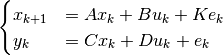
The shapes of the matrices are checked for consistency and will raise if inconsistent. If a matrix does not exist in the model representation, the corresponding
np.ndarrayshould have dimension zero along that axis. See the example below.An autonomous state-space model has no matrices
 and
and  .
An autonomous model with a one-dimensional internal state and output, can be represented as follows:
.
An autonomous model with a one-dimensional internal state and output, can be represented as follows:>>> model = StateSpace( >>> np.ones((1, 1)), >>> np.ones((1, 0)), >>> np.ones((1, 1)), >>> np.ones((1, 0)) >>> )
- Parameters
a – matrix

b – matrix
c – matrix

d – matrix
k – matrix
 , optional
x_init – initial state
 of the model, optional
y_column_names – list of output column names, optional
u_column_names – list of input column names, optional
- output(x: numpy.ndarray, u: Optional[numpy.ndarray] = None, e: Optional[numpy.ndarray] = None)
Calculate the output of the state-space model. This function calculates the updated
 of the state-space model in the class description.
The current state
of the state-space model in the class description.
The current state xis required. Providing an inputuis optional. Providing a noise termeto be added is optional as well.
- plot_input_output(fig: matplotlib.figure.Figure)
Given a matplotlib figure
fig, plot the inputs and outputs of the state-space model.
- step(u: Optional[numpy.ndarray] = None, e: Optional[numpy.ndarray] = None) numpy.ndarray
Calculates the output of the state-space model and returns it. Updates the internal state of the model as well. The input
uis optional, as is the noisee.
- to_dataframe() pandas.core.frame.DataFrame
Return the inputs and outputs of the state-space model as a dataframe, where the columns are the input- and output-columns.